


 Home
HomeThe 2026 UAV Battery Selection Guide: When (and Why) to Upgrade to 400Wh/kg
 2026-06-30
 0
0
For years, the UAV industry has chased a single metric: Energy Density (Wh/kg). Engineers believed that "higher is always better."
But in 2026, as industrial missions push the boundaries of distance and duration, the question has shifted. It’s no longer just about the highest number on a spec sheet; it’s about Strategic Necessity. Upgrading to 400Wh/kg semi-solid technology is a fundamental decision that determines whether your mission is a success or a costly failure.
If you are currently balancing payload against flight time, use this guide to determine if your platform has reached the "400Wh/kg Threshold."
1. Mission Duration: The "6-Hour Wall" and the 40/90 Rule
Your mission profile is the most honest indicator of your power needs.
Fixed-Wing & VTOL (The 6-Hour Wall): Mainstream VTOLs (Vertical Take-Off and Landing) are now hitting 6–8 hour endurance marks.
Case Study: Consider a 60kg-class VTOL (MTOW 63kg). A 6-hour mission at a 1.5kW average draw requires ~9,000Wh of energy.
Standard Battery (250Wh/kg): The pack would weigh 36kg—surpassing the airframe’s structural limit.
Mindway 400Wh/kg: The pack weighs only 22.5kg, leaving ample room for sensors and fuel/cargo.Mindway's 400Wh/kg semi-solid UAV battery series is engineered for long-endurance missions.
Decision Point: If your mission requirement exceeds 4 hours for VTOL, 400Wh/kg is no longer an "upgrade"—it is the only way to clear the runway.
2. Payload-to-MTOW Ratio: Are You Flying a "Drone" or a "Power Bank"?
A common design trap is allowing the battery to cannibalize the aircraft's potential.
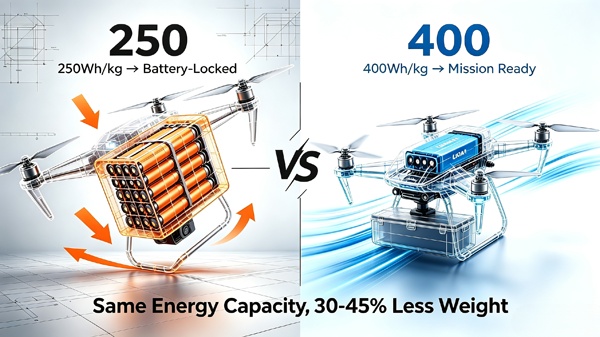
The "Battery-Locked" System: If your battery accounts for more than 50% of your Maximum Takeoff Weight (MTOW), you aren't flying a drone; you're flying a "flying power bank." This often forces you to "down-spec" your sensors—choosing a basic RGB camera over the high-res LiDAR your client actually needs.
The 400Wh/kg Advantage: By upgrading to semi-solid cells, you can reduce battery mass by 30-45% for the same energy capacity. This weight "rebirth" allows you to increase your effective payload ratio from 15% to 25%+.
Decision Point: If you are currently sacrificing sensor quality for battery weight, you are hitting the "Battery-Locked" ceiling. 400Wh/kg is your escape route.
3. Environmental Stress: Why Heat is the Ultimate Gatekeeper
High-altitude and high-temperature operations (desert surveying, solar farm inspections) introduce variables that liquid-electrolyte batteries cannot handle safely.
As explained in our [Engineering Formulas for Battery Heat Rise], heat generation (
The Mindway Difference: Our 400Wh/kg semi-solid technology features ultra-low impedance. During high-power discharge (like the critical VTOL take-off phase), our cells maintain a surface temperature 8-12°C lower than conventional cells.
High Altitude (>3,000m): Thin air reduces motor efficiency, requiring higher current. Only low-DCIR semi-solid cells can sustain this "high-burst" demand without risking thermal runaway.
4. The 2026 UAV Power Selection Matrix
| Mission Signal | Standard Li-ion (220-250Wh/kg) | Mindway Semi-Solid (400Wh/kg) |
| Mission Duration | Short sorties (< 45 mins) | Long-endurance (> 6-8 hrs VTOL) |
| Payload Priority | Basic sensors (Gimbal only) | Premium LiDAR / SAR / Logistics |
| Environment | Temperate, Low-Altitude | High-Temp (>45°C) or High-Altitude |
| Cost Strategy | Lowest initial CAPEX | Lowest Total Cost per Flight Hour |
| Safety Level | Standard | Terminator of Swelling / High Safety |
Use this matrix to compare standard Li-ion vs Mindway 400Wh/kg cells and choose the right power system for your mission.
Conclusion: Stop Guessing, Start Optimizing
In 2026, choosing a UAV battery is about optimizing the Power-to-Weight Ratio for your specific ROI. If your operations fall into the "Mandatory" categories in the matrix above, delaying the transition to 400Wh/kg is costing you in mission failure rates and payload capability.
Optimize your next build today.
📥 [Download the full [2026 UAV Battery Engineering Guide] for voltage matching formulas and DCIR spreadsheets.] (Includes: Voltage platform matching formulas, DCIR calculation spreadsheets, and a 60kg VTOL configuration template.)
👉 Looking to purchase 400Wh/kg UAV batteries for your fleet? Mindway offers OEM/ODM semi-solid cell solutions with global shipping and technical support.Explore our full UAV battery lineup or contact our engineering team for custom solutions.
📧 Contact: [email protected]
🌐 Website: mindwaybattery.com
📞WhatsApp: +86 18971062394