


 Home
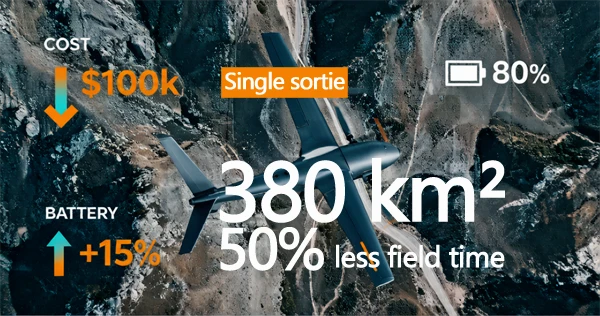
HomeSingle-Day Completion for 380 km² Corridor Projects: The Operational Economics of 400Wh/kg UAV Power
 2026-06-11
 0
0
Introduction:
For commercial drone mapping operators, profitability is won or lost on the ground, not just in the air.
While the physics of high-density cells are impressive, the real-world question is simpler: How much does it cost you to collect a square kilometer of high-precision data?
In large-scale aerial surveying, insufficient battery endurance does not just mean shorter flights. It triggers a cascade of operational inefficiencies—narrow light windows, repetitive launch deployments, and compromised sensor data. Here is a look at the operational logistics of mapping, and how Mindway’s 400Wh/kg semi-solid battery changes the financial equation.
1. The Hidden Costs of Multiple Sorties
1.1 The Relocation Tax
When a survey area exceeds 100 square kilometers, standard batteries force your field crew into a high-intensity transit loop.
They must pack up the launcher, drive through rugged terrain to a new deployment zone, recalibrate the RTK base station, and relaunch.
This "Relocation Tax" easily consumes 2–3 hours of a working day in pure transit, reducing actual flight time.
1.2 The "Sun Angle" Constraint
High-quality photogrammetry requires a high sun angle (typically
By delivering over 6 hours of continuous flight on a single charge, the 400Wh/kg series allows you to capture the entire target zone within a single day's optimal light window. The weather remains constant, the lighting is uniform, and post-processing time is slashed.
2. Guarding the Payload: Flatter Voltage for High-Precision Sensors
Endurance is meaningless if the data collected in the 5th hour is unusable.
Advanced payloads like LiDAR, multispectral cameras, and synthetic aperture radar (SAR) are highly sensitive to voltage fluctuations. Conventional lithium batteries experience significant voltage sag as they discharge, especially under high current demands. This sag can cause:
Inconsistent point-cloud density.
Signal drift in high-resolution optical sensors.
Telemetry misalignment during data merging.
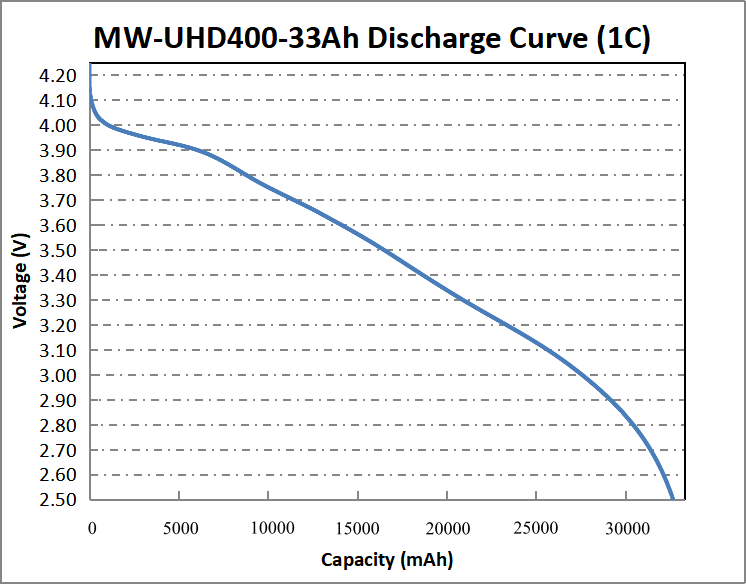
Mindway’s semi-solid architecture maintains an incredibly flat discharge curve at 3V~4.25V. Throughout a 5+ hour mission, the power delivery to your LiDAR remains rock-solid. You get clean, uniform data from takeoff to landing, meeting strict 1:1,000 scale mapping accuracy requirements without redundant sweeps.
3. Case Study: High-Altitude Forested Survey (380 km²)
The Challenge
A provincial forestry project required mapping 380 km² of mountainous terrain (altitudes exceeding 2,800m). Traditional liquid-lithium setups required 4 separate takeoff sites due to altitude-induced battery performance drops, meaning hours of mountain driving and high crash risks during multiple rough-terrain landings.
The Solution & Execution
The operator integrated Mindway's UHD400-33Ah semi-solid battery pack. Flying a customized single-sortie path from a single base camp, the UAV stayed airborne for 5 hours and 50 minutes, covering the entire 372 km² in one flight.
The Outcome
Takeoff/Landing Risk: Reduced by 75% (from 4 sites to 1).
Operational Logistics: Repositioning costs were cut by 70%.
Data Integrity: The stable voltage platform ensured the LiDAR point-cloud density remained consistent even during high-altitude wind gusts in the 5th hour of flight.
4. The Economics: 380 km² Project Balance Sheet
| Metric | Traditional Liquid Li-ion (200Wh/kg) | Mindway Semi-Solid (400Wh/kg) | Net Operational Impact |
|---|---|---|---|
| Sorties Needed | 4 | 1 | ⬇️ 75% lower takeoff/landing risk |
| Field Labor Hours | 32 man-hours (2 crew × 2 days) | 16 man-hours (2 crew × 1 day) | ⬇️ 50% lower project payroll |
| Ground Transit | 4 deployment sites | 1 deployment site | ⬇️ 75% less travel wear-and-tear |
| Data Mosaicking | Complex (due to multi-day lighting differences) | Simple (single-day uniform light) | ⬇️ Faster client delivery |
For a mapping provider running 50 such projects annually, this shift translates to saving over 800 field man-hours and boosting project net margins by 20% to 30%.
5. Tailored Power for Your Fleet
Mindway’s UHD400 semi-solid battery catalog is designed for fast integration into commercial fixed-wing and VTOL airframes.
Custom Form Factors: Tailored to fit narrow fuselage constraints.
Low Impedance: ACIR <2mΩ for minimal heat generation.
Extreme Weather Tolerance: Proven discharge stability from -20°C to 55°C.
👉 Download the UHD400 Mapping Battery Catalog
📩 Get a Custom Thermal and Power Integration Quote