


 Home
HomeThe Science of Endurance: Why Wh/kg is the Ultimate Metric for Aviation Power
 2026-04-24
 0
0
In the world of aviation, there is an invisible enemy that dictates every design decision: Gravity.

For electric flight—whether it’s a tactical UAV, a high-altitude solar aircraft, or a next-generation eVTOL—the success of a mission isn't just about how much power you have, but how much that power weighs. This is why engineers don't just ask about capacity; they ask about Wh/kg (Watt-hours per kilogram).
In this article, we’ll explore why Energy Density (Specific Energy) is the "Holy Grail" of aerial propulsion and how Mindway’s breakthrough in 400Wh/kg and 500Wh/kg technology is redefining the limits of flight.
1. Understanding the Metric: What is Wh/kg?
In technical terms, Wh/kg refers to Gravimetric Energy Density, often called Specific Energy. It measures how much energy (Watt-hours) a battery can store for every kilogram of its weight.
When you see a search for "density battery w kg," it represents a quest for the most efficient energy-to-weight ratio.
Low Wh/kg: Means a heavy battery that consumes most of its own energy just to lift itself off the ground.
High Wh/kg: Means a lightweight power source that allows the aircraft to carry more sensors, fly further, and stay airborne longer.
2. The "Weight Penalty" and the Flight Time Bottleneck
Why is this metric more important than total capacity? Because of the Flight-Weight Spiral.
In a standard drone design, if you want to double the flight time, you might think of doubling the batteries. However, doubling the batteries doubles the weight. The extra weight requires more thrust, which draws more current, which drains the batteries faster.
For years, the industry was stuck with standard Lithium-ion batteries hovering around 240–260 Wh/kg. This created a "glass ceiling" where most industrial drones could rarely exceed 30–40 minutes of flight time with a meaningful payload.
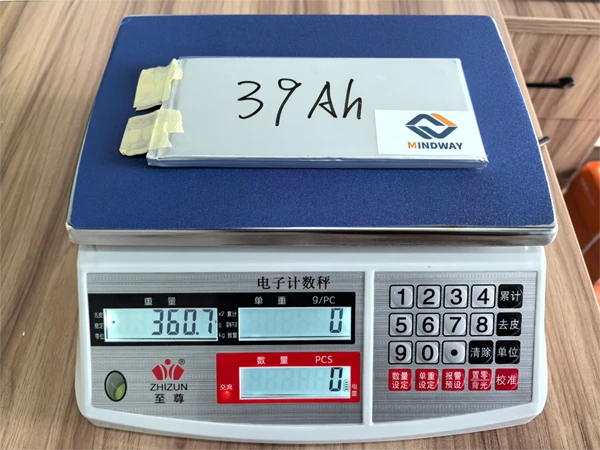
Experience the incredible lightness of Mindway’s 400Wh/kg cell.
3. The Turning Point: How 400Wh/kg Changes the Game
When energy density moves from 250Wh/kg to 400Wh/kg or 500Wh/kg, the physics of the mission changes completely.
Extended Endurance: At 400Wh/kg, the "weight penalty" is drastically reduced. This allows tactical UAVs to break the 60-90 minute barrier, enabling BVLOS (Beyond Visual Line of Sight) missions that were previously impossible.
SWaP-C Optimization: By maximizing the density battery (Wh/kg) rating, we address the core principles of SWaP-C (Size, Weight, and Power, at a lower Cost of operation). You get more power in a smaller, lighter footprint.
Increased Payload Capacity: Every kilogram saved on the battery is a kilogram gained for LiDAR, high-res cameras, or tactical equipment.
👉 400Wh/kg battery VS 240 Wh/kg battery
| Battery Type | Energy Density | Area Covered (Single Flight) | Battery Swaps Needed |
| Standard LiPo | 240 Wh/kg | 50 Hectares | 3 Times |
| Mindway 400Wh/kg | 400 Wh/kg | 120+ Hectares | 0Times |
4. Engineering the Future: Beyond the Chemistry
Reaching the 450Wh/kg frontier isn't just about choosing a different powder for the electrodes. It requires a holistic engineering approach:
Advanced Chemistry: Utilizing silicon-based anodes and high-nickel cathodes.
Structural Integration: Moving toward Cell-to-Pack (CTP) designs to remove "dead weight" from the housing.
Thermal Management: Ensuring that high-density cells remain stable during high-power takeoffs.
5. Why Mindway?
At Mindway, we don't just manufacture batteries; we engineer Endurance Solutions.
Our R&D core—comprised of experts from the aerospace and defense sectors—has successfully pushed the boundaries of Specific Energy. By delivering batch-produced 400Wh/kg systems, we are helping our partners in the eVTOL and UAV industries achieve what was once considered "the impossible."
Better Energy Enables Better Flight. When you optimize for Wh/kg, you aren't just buying a battery—you are buying mission success.
FAQ
Q: Why is battery density measured in Wh/kg (w kg)?
A: Measuring battery energy density in Wh/kg (watt-hours per kilogram) allows engineers to calculate the potential flight time relative to the aircraft's takeoff weight. A higher Wh/kg value directly translates to longer endurance.