


 Home
HomeBeyond 220Wh/kg: Why Energy Density is the "Force Multiplier" for UAV Mapping
 2026-06-02
 0
0
Introduction: The 3-Hour Glass Ceiling
For years, the UAV mapping and inspection industry has been stuck at the "3-hour glass ceiling." Standard Li-ion batteries (220–250Wh/kg) simply carry too much "dead weight" for long-range missions. You add more cells to extend flight time, but most of that added energy is consumed just to keep the extra battery mass airborne. The result: diminishing returns, frequent landings for battery swaps, and missions that span multiple sorties.
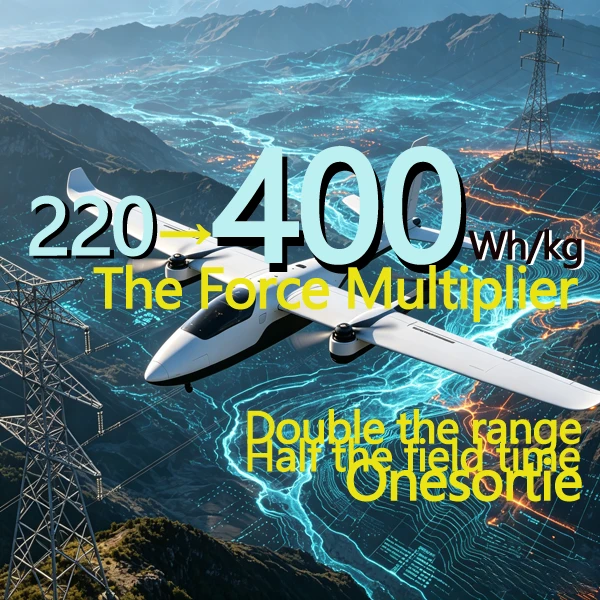
At Mindway, we see energy density differently — not as a static specification, but as a Force Multiplier. By moving from 220Wh/kg to 400Wh/kg, you aren't just flying longer. You are completing missions in a single sortie that previously required three.
This isn’t just about making the battery better; it’s about making the mission possible. When you remove the need for two extra landings, you remove 66% of the take-off/landing risks and 100% of mid-day battery swap downtime.
Physical Reality: The Weight Penalty
Every extra gram of battery consumes its own energy just to stay airborne. This is the weight penalty — a fundamental constraint in aviation. For a typical industrial UAV with 220Wh/kg cells, the battery pack often accounts for 35–45% of takeoff weight. When you increase battery size to gain endurance, a large fraction of the added capacity is stolen by the weight penalty.
The 400Wh/kg advantage changes the equation entirely. At the same battery weight, you get nearly double the usable energy. Alternatively, for the same mission endurance, you can cut battery weight in half — liberating payload capacity for high-value sensors.
220Wh/kg vs. 400Wh/kg: More Than a Number
The following comparison uses identical battery weight (10kg) on a fixed-wing mapping UAV under real-world cruise conditions.
| Parameter | 220Wh/kg Standard Liquid Lithium | Mindway 400Wh/kg Semi-Solid |
|---|---|---|
| Total energy | 2200 Wh | 4000 Wh |
| Battery weight | 10 kg | 10 kg |
| Takeoff weight (with 5kg payload) | ≈30 kg | ≈30 kg |
| Cruise power | 1800 W | 1800 W |
| Endurance | ≈1.22 hours | ≈2.22 hours |
| Payload gain (at same endurance) | — | +4–5 kg |
Note: While the table shows a direct performance leap on a standard platform, Mindway’s optimized airframe integrations have successfully achieved the 6-hour milestone.
What this means in the field:
Double the range, double the area coverage, half the field time.
A single 400Wh/kg battery allows a mapping drone to cover 80–100 km² per flight instead of 40–50 km².
Three separate takeoffs, landings, and battery changes become one seamless sortie.
Safety: Semi-Solid Eliminates the Thermal Runaway Trade-off
Higher energy density used to mean higher risk — especially with volatile liquid electrolytes. Mindway’s 400Wh/kg battery uses semi-solid-state electrolyte, which fundamentally changes the safety profile:
Non-flammable, non-leaking: Even under puncture or overcharge, no thermal runaway.
Wider temperature window: -20°C to 50°C operation.
Passes aviation-grade abuse tests (nail penetration, crush, overcharge).
When comparing semi-solid-state vs. liquid lithium, the key difference is that safety is no longer a statistical compromise. This makes 400Wh/kg not only a performance breakthrough but also a mission-reliability enabler.
From Tool to Strategic Asset
A 220Wh/kg drone is a tool — useful, but limited. A 400Wh/kg drone is a strategic asset:
6-hour flight times become practical for wide-area border patrol, pipeline monitoring, and large-scale mapping.
Heavy payloads (LiDAR, SAR, multispectral arrays) can be carried without sacrificing endurance.
ROI improves dramatically: Fewer sorties, less ground crew time, lower risk of mid-mission battery failure.
As one mapping operator put it: *“With 220Wh/kg, we plan for three flights to cover a site. With Mindway’s 400Wh/kg, we plan for one.”*
Conclusion: Energy Density is the Force Multiplier You’ve Been Missing
Moving from 220Wh/kg to 400Wh/kg is not just a 1.8x increase in numbers — it is a fundamental change in mission economics. The weight penalty is tamed. The 3-hour glass ceiling is shattered. And the drone becomes a platform capable of single-sortie completion of tasks that once required a fleet.
Double the range. Double the area coverage. Half the field time.
That is the power of energy density as a force multiplier.
CTA:
👉Field-Proven Results: See how these performance gains translate into real cost savings and operational efficiency: Single-Day Completion for 380 km² Corridor Projects: The Operational Economics of 400Wh/kg UAV Power
👉 Explore our 400Wh/kg High-Density Series – and see how Mindway can transform your UAV mapping ROI.